Learning to Fly
If you want to learn to hang glide then your best bet is to go to a BHPA registered school. The BHPA maintains a list of all registered schools in the UK along with appropriate contact information; this is the best starting point. The next step is to research your chosen school a little. Find out what sites they use and do they have sites suitable for all wind directions? How much do they charge (daily or a flat fee for the entire course)? If possible, see if you can get recommendations from someone (you may find there is a local hang gliding club that may help here), some schools are much better than others!
Next, decide what time of the year you would like to learn. Generally the summer months are better when learning to fly in the UK, although some schools run trips abroad during the winter months. Consider the fact that Hang Gliding is weather dependent, and although you may decide to take a week off work to do your course, you may find that the weather will not be suitable for some, or possibly all of those days (be prepared for this and have a 'B' plan; home DIY, places to visit?). Alternatively you could learn at weekends, but be prepared for a much busier school, and of course, that bad weekend weather! If opting to learn overseas, make sure you have appropriate insurance (the schools may only cover themselves).
The one thing that I never considered when learning to fly was my fitness. I had visions of hang gliding being an effortless sport of gliding through the air! Little did I know! During the learning phase there will be a lot of walking up hills, pushing the school's glider to the top readying for your next flight!
If you're unsure of the sport perhaps try a day's taster. Most schools run a taster day where you can try it out then decide if it's really for you. Generally, the taster day is day one of the Elementary Pilot course. Any reasonable school will use your payment from the day's taster towards your Elementary Pilot course if you continue your training (ask your chosen school about this).
Finally, have a budget. Consider the cost of both the Elementary Pilot (EP) course and the Club Pilot (CP) course, both of which are required before you can leave the safety of the school and join a flying club. Invariably, learning to fly in the UK may involve a few wasted trips, stay overs, pub lunches and of course, if you really enjoy it, your own glider and kit (keer ching!).
Elementary Pilot (EP)
Okay, I've mentioned that Elementary Pilot thing a few times now but not explained what it is. Well, the Elementary Pilot course is basically concerned with the basics of hang gliding. The course generally runs from 4 to 5 days and by the end of that you'll be flying around 50 feet above the ground from the top of the hill to the bottom (generally referred to as a top to bottom!). This of course, is still in the safety of the school environment.
On your first day you will be introduced to your instructor, money will be exchanged and you'll become a member of the BHPA, which covers you for 3rd party liability insurance. Normally you'll be given a safety talk and made to sign a disclaimer form. You'll then be transferred to the training site, where you will be introduced to your first hang glider (normally a floater such as an AirBorne Fun). You'll be instructed on the correct way of setting up the glider and shown how to check that the glider is in an airworthy condition. You'll be supplied with a harness and helmet, and after a quick talk, you'll be ready for your first flight! Don't worry; you probably won't leave the ground on your first flight.
The first flight is normally flying the glider (not yourself). You'll be positioned on a slight gradient facing into wind and instructed to run with the glider, down the hill. At some point during this run, the glider will seamlessly float above you. This is your first flight. You'll then have to carry/push the glider back up the hill to your starting point (this is why it helps to be fit).
Your instructor will gradually build you up to a point where you'll be in a position to do a skimming flight (that's when your feet leave the ground and you skim across the grass). You may well be attached to the instructor(s) via tethers for this exercise. The instructor will only use these to correct any turns or any un-intentional pitch control that you may induce on the glider.
As you progress, you will advance further up the hill; flights will become longer with more airtime (you'll also have further push the glider after each flight - this is why you need to be reasonably fit to train!). Eventually the hills will start to become too big which is a good sign that you're nearing the end of the EP course!
After successfully completing simple flying tasks such as good controlled take-offs/landings, roll control (turning) and pitch control of the glider (the nose going up and down) you'll be ready to complete the Elementary Pilot course. On completion of the Elementary Pilot course you'll sit a multiple-choice exam that contains questions on air law and the basics of flight theory. After passing this exam you'll be awarded your elementary pilot (and you get a badge!). You're now ready to do your Club Pilot course.
Tether Flights
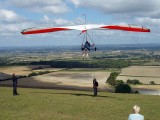
If you're lucky and the wind is too strong for normal training; you may have the opportunity to experience tethered flights. This is essentially your instructor flying you and the glider a bit like a child flies a kite! This closely resembles a soaring flight where you'll actually be flying, albeit safely coupled to the ground by tethers with the real flying done by the instructor
It's a great way to to feel what it's like to truely fly a glider and can be done with very minimal training. The video below illustrates some early students being tether flown at Bo Peep (I wished I'd had this experience during my training!).
Club Pilot (CP)
At the start of the club pilot course some students purchase their own personal equipment, including the glider (to be used this during the course). There are advantages in doing this, primarily; you get familiar with your own kit whilst still in the safety of the school. I opted not to do this for several reasons, although possibly the most important was I didn't want to damage a new glider with aluminium bending landings (as is most common in the training stage!).
The club pilot course's main aim is getting you to a standard where you're proficient to fly un-supervised (in a local flying club). During the club pilot course you'll be taught how to fly in prone position (that's the lying down bit in the pod harness or stirrup), instructed in performing simple but controlled turning manoeuvres, how to handle nil-wind landings/take-offs and best of all, you'll need to do two soaring flights (which will take you 200 feet above the ground, with flights lasting more than 5 minutes each!). Often, the schools move to more advanced hills, not the simple gradients used during the Elementary Pilot course, but much higher and steeper ones. This results in more time in the air, giving you the chance to concentrate more on the flying, rather than the take-off followed by an immediate landing! Another benefit is the hills are often too steep to push or carry the glider up again, so the school will normally provide transport from the bottom to the top!
The only problem with doing the Club Pilot course in the UK is getting the correct weather for doing the soaring part. I was fortunate in that I'd completed the non-soaring tasks in the Club Pilot course by day 4. Day 5 was my soaring day and I was now waiting for the correct conditions. I only had to wait 1 week for the right wind direction and strength. I had two flights, one lasting 30 minutes and the other lasting 25 at the Devils Dyke (West Sussex). Amazing! I was lucky with the weather. Some students have found themselves waiting for months, so be prepared.
The Learning Never Stops
Okay, so you've become a club pilot (a novice). What does this mean? Well, you're ready to fly unsupervised (out of the school environment) and join a local flying club. I emphasise unsupervised, as this doesn't really mean alone; it's always a good idea, particularly in your early days, to make sure that someone experienced has a watchful eye on you. Joining a flying club is the best way to do this. Most good clubs have active coaches who are more than willing to offer advice to new pilots. I often found myself speaking to a coach or more experienced pilot before I flew, just to get a quick brief on the flying site and weather conditions. Never be afraid to ask and don't forget, on those iffy days, you're better of being on the ground than in the air wishing you were on the ground!
Flying in a club requires a more disciplined approach. You will need to assess weather forecasts to determine if the next few days are suitable for flying, be able to assess the conditions on the day and have the confidence to make the right decisions. All of this is taught during the Elementary and Club Pilot courses, but you're now putting this into practice.
For me personally, after a year of qualifying my confidence levels weren't as high as I would have liked. Fortunately, my hang-gliding instructor organised an overseas flying trip to the Sierra Nevada in South Spain. I was invited, along with other former students, and found myself flying fantastic sites in perfect weather. This was all under the watchful eye of my former instructor and it was simply amazing! A trip like this is a great way to get plenty of flying in and meet new flying buddies!
As you progress in the sport you'll become more proficient flying your own glider, you'll learn its capabilities and your own. When soaring you'll start thinking about what the air around you is doing and how to use this to keep you in flight. Eventually, you'll progress to more advanced flying, searching for thermals and leaving the hill and setting off on your first cross-country!
Other Environments / Disciplines
There are further qualifications that can be obtained (Pilot/Advanced Pilot etc) which 'should' be obtained before proceeding on cross-country flights. There are also different flying 'environments' or disciplines that you can qualify into. This basically means different ways of getting into the air. Most qualify for the hill environment (foot launching from hills), but you can also tow (pulled into the air by a ground based winch) and aerotow (towed into the air behind a microlight).
Final Thoughts
I have never regretted learning to fly. In the early stages it may seem that more effort is put in than reward gained from it, especially during the Elementary Pilot course. Often, students drop out after completion of the Elementary Pilot. I had a year's break between my Elementary Pilot and Club Pilot! I can only stress, be patient and stick with it. As a friend of mine simply put it;
"Learning to hang glide has an exponential function; at the beginning you put heaps of effort in and don't get much out, but in time you'll put minimal effort in and the reward is amazing."
And do you know what? He wasn't wrong!
Update History: